
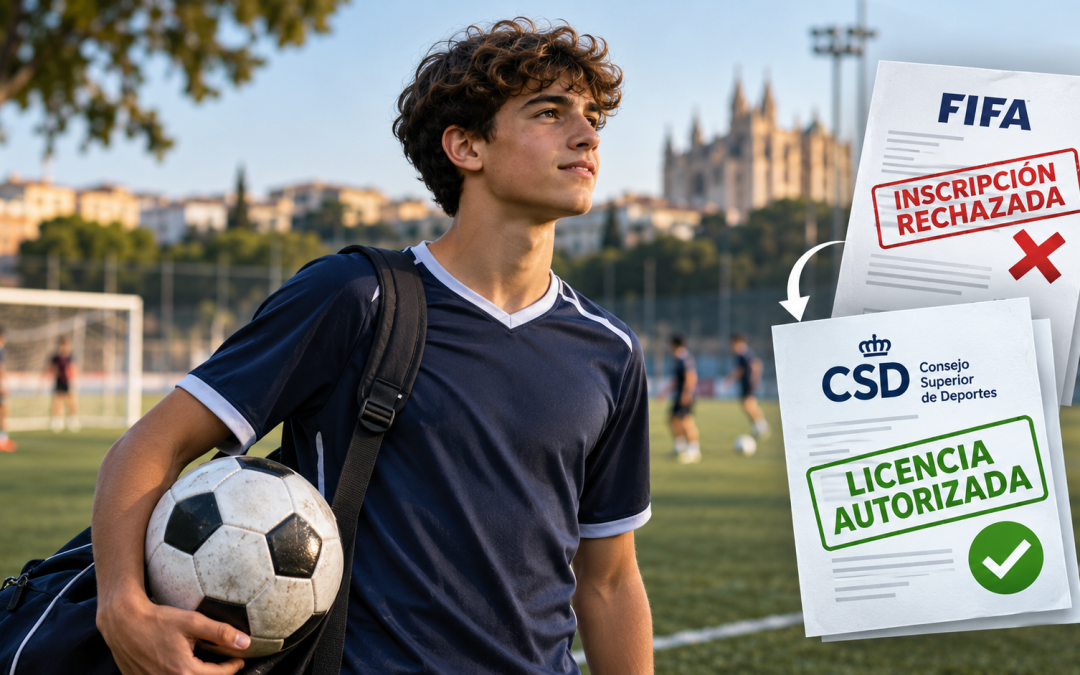
What happens when a foreign minor legally resides in Spain, studies here and wants to continue playing football, but FIFA rejects their registration because they do not meet the requirements of one of the exceptions provided for international transfers of minors?
The answer might seem straightforward: if FIFA does not authorise the registration, the minor cannot play.
However, the Spanish Sports Council (Consejo Superior de Deportes – CSD) has once again demonstrated that, when it comes to football licences in Spain, the answer does not necessarily end with FIFA regulations.
In a new decision dated 6 November 2026, the CSD upheld the appeal filed by Himnus Football Lawyers on behalf of the family of a foreign minor whose licence had been rejected by the RFEF after the application submitted to FIFA was unsuccessful.
The decision once again emphasises a principle that, following numerous decisions reaching the same conclusion, is becoming increasingly difficult to regard as exceptional: when a foreign minor legally resides in Spain and wishes to participate in a non-professional competition, that legal residence is a key factor in obtaining their football licence.
A European minor attending school in Spain but unable to obtain a football licence
The case concerns a 15-year-old minor, an Italian national and therefore a citizen of the European Union, who moved to Spain to continue his education.
During the 2026/2027 academic year, he was attending a Spanish school in person, had accommodation, was registered with the local municipality and held the corresponding Certificate of Registration as a Citizen of the European Union. His legal and effective residence in Spain was therefore fully established.
Like any other minor moving to another country, he wanted to continue practising the sport that was already part of his life and applied to register with a football club. That was when the problem arose.
As he was a minor player coming from abroad, the application was subject to the procedure established for international transfers and first registrations of minors. Specifically, the application was submitted under the exception applicable to students temporarily relocating for academic reasons.
FIFA rejected the application because that exception requires, among other conditions, that the new club be a purely amateur club, with no professional team or links to a professional club, a requirement that was not met in this case.
The consequence was immediate: the RFEF refused to process and issue the licence. The minor legally resided in Spain, studied here and was fully integrated, but could not participate in competitions.
The issue was not whether he met a FIFA exception
The dispute could have focused on determining whether the minor met the specific requirements of the student exception under Article 19 of the Regulations on the Status and Transfer of Players (RSTP).
However, the CSD once again shifts the debate to a different question: what requirements does Spanish law actually impose for a legally resident foreign minor to obtain a licence and participate in a non-professional competition?
The Spanish Sports Act establishes that restrictions may not be imposed on the issuance of licences to foreign nationals who legally reside in Spain, except those arising from applicable national or international federation regulations that have been recognised by international organisations composed of States (former Article 9).
And this is precisely where an issue that the CSD has repeatedly addressed in the same way arises once again.
The CSD again refers to the November 2024 report of the Spanish State Legal Service, according to which there is no evidence that the RSTP has been formally recognised, as required by the Spanish Sports Act, either by the Council of Europe or by the institutions of the European Union.
Consequently, FIFA’s international regulations cannot be used in Spain to impose on a legally resident minor a restriction that is not provided for under Spanish law.
Legal residence is once again the key
Once that issue had been resolved, the CSD’s conclusion was particularly clear. The minor held a Certificate of Registration as a Citizen of the European Union and had established his legal residence in Spain. According to the Council, that circumstance was sufficient to participate in official non-professional sporting activities.
The decision once again uses wording that we have already seen in previous proceedings:
“Legal residence in Spain is sufficient to obtain the licence requested from the RFEF, which entitles the applicant to participate in the non-professional competition in question.”
In other words, one thing is for an application not to fall within a particular exception provided for under FIFA regulations, and quite another for that rejection to be automatically applied in Spain to prevent a minor who legally resides in the country from obtaining a football licence. This distinction is fundamental for families.
A legal doctrine that is becoming increasingly difficult to dispute
In recent years, we have seen cases involving Spanish minors returning from abroad, legally resident foreign minors, citizens of other European Union Member States and even cases in which the RFEF had not issued an actual refusal decision but had simply blocked the processing of the application.
And the CSD’s position continues to move in the same direction: FIFA regulations cannot be applied in Spain independently of the safeguards and rights recognised by the Spanish legal system.
Naturally, this does not mean that Article 19 of the RSTP is irrelevant or that any international transfer of a minor can take place without complying with FIFA regulations. Its purpose of protecting minors against relocations linked exclusively to football addresses a legitimate concern.
The problem arises when those regulations ultimately prevent a minor who is already legally established in Spain, and whose right to participate in sport is expressly recognised by Spanish legislation, from taking part in a non-professional competition.
What can a family do if FIFA or the RFEF rejects the licence?
For parents facing this situation, the distinction between FIFA, the RFEF, a regional football association or the Spanish Sports Council is probably of secondary importance.
The reality is much simpler: their child lives in Spain, attends school and trains with his teammates, but every weekend he has to be left out of the matchday squad because he does not have a licence.
And many families assume that, if FIFA has rejected the application, there is no alternative. This new decision once again demonstrates that this is not necessarily the case.
Each case must be assessed individually. The minor’s nationality, residence, registration history, the type of registration requested and the actions taken by the RFEF may substantially affect the legal analysis. However, a negative decision within the FIFA procedure does not always mean that the minor must remain unable to compete until reaching the age of majority.
At Himnus Football Lawyers, we have been involved in these types of proceedings for years, and this latest successful appeal adds to other favourable decisions obtained before the Spanish Sports Council concerning licences for minors.
It is precisely because of this experience that one of the first issues to examine when a licence is refused is whether the matter truly ends with FIFA or whether, on the contrary, rights recognised under Spanish law allow the Federation’s actions to be challenged.
Once again, the CSD has made it clear: a foreign minor who legally resides in Spain has the right to participate in non-professional sport, and that legal residence is sufficient to obtain their licence.
Abel Guntín
Associate